
In the renewable energy sector, a new term—BESS (Battery Energy Storage System)—has become very popular over the last two years. The main reasons for its growing adoption are rising diesel costs and the increasing need for a stable national grid. While BESS has been widely used in many overseas countries, it is now gaining popularity in India.
In this blog, we will understand what a Battery Energy Storage System (BESS) is, how it works, its major components, and why it is becoming an important technology after solar power.
First, we understand that What is a Battery Energy Storage System (BESS)?
The term Battery Energy Storage System (BESS) consists of three words: Battery, Energy Storage, and System. A battery is a device that stores chemical energy and converts it into electrical energy. We have explained battery fundamentals in detail in another article, which you can refer to for a better understanding. Energy Storage means storing energy generated from different sources such as solar power, wind power, hydro power, or other energy sources. The word System refers to the complete process of charging and discharging energy, including AC-to-DC and DC-to-AC power conversion. When all these components work together as a single integrated solution, it is called a Battery Energy Storage System (BESS).
Now, we understand that How does a Battery Energy Storage System (BESS) work?
Most people are already familiar with inverter batteries, which have been used for many years to provide backup power during electricity outages in homes and businesses.
The working principle of a BESS is similar, but it offers additional benefits. It can operate in both on-grid and off-grid modes while also helping reduce electricity costs.
In several Indian states, such as Maharashtra and Bihar, electricity tariffs vary depending on the time of day. The tariff is generally divided into three time periods:
- Normal Hours: 9:00 AM to 5:00 PM
- Peak Hours: 5:00 PM to 11:00 PM
- Normal Hours: 11:00 PM to 9:00 AM
Electricity costs are higher during peak hours due to increased power demand and changing consumption patterns.
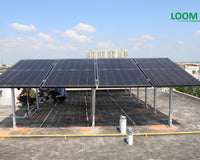
In a BESS, excess solar energy generated during the daytime is stored in the battery. During peak hours, the stored energy is supplied to the load instead of drawing expensive electricity from the grid. This helps reduce electricity bills while also supporting grid stability during periods of high solar generation.
Now, we understand that What are the major component of a Battery Energy Storage System (BESS)?
A Battery Energy Storage System consists of several major components, including:
- Battery
- PCS/PV Inverter
- Energy Management System (EMS)
- Cooling System (Air or Liquid)
- Thermal Management System (TMS)
- Smoke Detectors
- Multiple Sensors
- Switchgears
- Internal Power Cables
- Enclosure
- Display and other supporting components
Let's understand each component briefly.
1. Battery
The battery is the most important component of a BESS. Loom uses LFP (Lithium Iron Phosphate) battery technology because it offers high reliability, long life, and excellent safety.
Currently, LFP cells with capacities of 100Ah, 280Ah, and 314Ah are widely available in the market. Using these cells, Loom manufactures battery packs ranging from 1kWh to 5MWh.
The battery contributes nearly 50–60% of the total BESS cost, making it the most critical component of the system.
There are two types of batteries:
Low Voltage Batteries: Low-voltage batteries are widely used in the Indian residential and small commercial market. Loom offers CAML battery models in 1kWh, 2.5kWh, 5kWh, 10kWh, and 15kWh, which are suitable for hybrid backup systems up to 20kW.
High Voltage Batteries: High-voltage batteries are mainly used in commercial, industrial, and utility-scale applications. Loom offers high-voltage battery packs starting from CAML 5kWh (50Ah, 104.6V) up to CAML 52kWh (314Ah, 166.4V).
Using these battery packs, various BESS capacities can be designed, including:
- 30kW/60kWh
- 50kW/100kWh
- 125kW/261kWh
- 500kW/1044kWh
- 1MW/2MWh
- 1.25MW/2.5MWh
- 1.25MW/5MWh
- 2.5MW/5MWh
and many more.
2. PCS / PV Inverter
The second major component is the Power Conversion System (PCS) or PV Inverter. Since batteries store DC power, a power converter is required to convert AC to DC during charging and DC to AC during discharging. If the battery is charged only from the grid, a PCS is used.
If the battery is charged from both solar and grid power, a PV Inverter (Hybrid Inverter or String Inverter) is used. The selection depends on the application, system capacity, and budget.
For systems up to 50kW, hybrid inverters are commonly used in homes, schools, hospitals, hotels, offices, and small businesses. For larger systems above 50kW, PCS units with capacities of 100kW, 125kW, and 250kW are generally recommended. Both PCS and PV inverters support parallel operation, allowing the system capacity to be expanded whenever required.
3. Remote Monitoring System (RMS) / Energy Management System (EMS)
The Energy Management System (EMS) is the software platform used to monitor and control the complete BESS.
It provides real-time information about battery performance, PCS/inverter status, charging sources, load priority, alarms, and other important parameters.
Since the platform is cloud-based, service engineers can monitor and troubleshoot the system remotely without visiting the installation site in many cases.
Loom has developed its own cloud platform, gridai.loomsolar.com, where inverter and system data can be monitored remotely.
4. Cooling System
The cooling system plays an important role in maintaining battery life and overall system performance. Small BESS systems (up to 50kW) generally use natural or air cooling. Larger systems, such as the 125kW/261kWh BESS, use a liquid cooling system.
Each battery pack is connected to liquid cooling plates, and the cooling system starts automatically whenever the BESS operates. In smaller systems, the cooling system uses an internal auxiliary power supply, while larger systems such as 1.25MW/5MWh have a dedicated auxiliary power supply for the liquid cooling system.
5. Thermal Management System (TMS)
The Thermal Management System (TMS) is another important safety component. During operation, batteries and power electronics generate heat. If the temperature rises beyond the permissible limit, battery performance and life may reduce.
The TMS continuously monitors system temperature and sends information to the EMS. If abnormal temperature conditions are detected or the TMS does not function properly, the BESS automatically shuts down to protect the system.
Apart from these major components, a BESS also includes internal power cables, switchgears, enclosures, displays, sensors, smoke detectors, and other supporting equipment. For detailed information, you can refer to the respective product manuals.
Conclusion
In this BESS buying guide, we have explained the fundamentals of a Battery Energy Storage System to help you understand its basic working and major components.
Whether you are planning to install a BESS for your home, business, or manufacturing plant, understanding these fundamentals will help you choose the right solution.
Loom is a leading BESS manufacturer in India with over eight years of experience in solar and energy storage solutions. If you have any questions about BESS or need help selecting the right system, feel free to leave a comment below. We will try to answer your questions in our upcoming blogs.
For more details, speak with our BESS expert, Mr. Nishi Chandra, at 9650443724 or email nishi@loomsolar.com