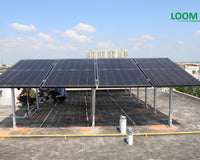

The Indian solar energy sector is moving at an impressive speed. As of March 31, 2026, the country has reached a cumulative installed solar capacity of 150.26 GW, adding a record of 44.6 GW in a single financial year, making it one of the fastest-growing markets in the world. With millions of homeowners and businesses installing solar systems, this is when the quality of solar panels has never been more important.
This is where ALMM solar panels take place. ALMM stands for Approved List of Modules and Manufacturers; it is a government-backed quality framework introduced by the minister of new and renewable energy (MNRE). It act as an official stamp of approval, which helps the buyers in identifying the solar panels that meets the India’s quality and performance standards
Whether you are a homeowner or a businessman looking to go solar or someone who is simply researching solar. Understanding the ALMM-approved list by MNRE can help you in understanding the most important step before making a purchase. Read this blog to know more.
What is ALMM in solar panels?
ALMM stands for Approved List of Modules and Manufacturers. It is a mandatory registration and certification framework introduced by the MNRE to regulate the quality of the solar photovoltaic (PV) modules used in India.
The ALMM scheme was established under the approved model and manufacturers of solar photovoltaic modules order, 2019. It was issued on 2 January 2019. The first ALMM list-I was issued on 10 March 2021.
Following are the contents that the ALMM list contains; the MNRE ALMM list is divided into parts:
-
List I—Solar PV Modules: This is a primary and currently active list. It covers finished and commercialized solar panels, ensuring the panel utilized in the state-sponsored projects meets quality, reliability, and long-term warranty standards. This list is updated regularly; the last update was on March 1, 2026.
-
List II—Solar Cells: Introduced in September 2025, this list covers domestic cell manufacturers and regulates the actual photovoltaic cell that will be used inside the finished modules. From June 1, 2026, the use of ALMM list-II certified cells has become mandatory for new solar projects.
The main reason behind the introducing the ALMM was to protect consumers and and project developers from the low-standard solar panels and to reduce the country’s import dependence and boost India's domestic solar manufacturing market.
Why are ALMM-approved solar panels important?
It is important for buyers to choose ALMM-approved solar panels because it carries real and practical benefits for the buyers.
Following are some of the importance of choosing an ALMM-approved solar panel:
-
Quality assurance: To be listed on the MNRE ALMM list, a manufacturer has to pass the stringent quality tests and also the certification requirements stipulated by recognized bodies like the National Institute of Solar Energy (NISE). This means that every ALMM-listed panel has been tested for performance, efficiency, and durability, giving you real peace of mind.
-
Eligibility for government subsidies: This is a key moment for homeowners. Your panels must be from ALMM-approved manufacturers under schemes such as the PM Surya Ghar Muft Bijli Yojana, which offers subsidies of up to Rs 78,000 for a 3 kW rooftop solar system. If you install non-ALMM panels, you will not be eligible for these government incentives that can pay for 30-40% of the total installation cost.
-
Reliable performance and after-sales support: ALMM-listed companies are established and accountable domestic companies having proper manufacturing facilities and service networks in India. That means better warranty enforcement, customer support, and a better chance of getting service on time, which is especially important on a 25-year investment.
-
Compliance with government and utility projects: ALMM-approved solar panels are legally required for commercial projects, open access installations, and any project financed or supported by government agencies (including SECI tenders). Such projects cannot use panels that are not ALMM.
-
Supporting India’s energy self-reliance: By choosing ALMM solar panels, buyers are directly contributing to India’s mission of decreasing its solar import dependence and establishing a strong domestic solar manufacturing base, a goal that is at the heart of both the PLI Scheme and the National Solar Mission.
ALMM solar panels vs non-ALMM solar panels
To understand why ALMM solar panels are important, here is the difference between ALMM solar panels and non-ALMM solar panels for better understanding:
|
Features |
ALMM solar panels |
Non-ALMM solar panels |
|
Quality Standard |
It is verified by MNRE and meet BIS and National Testing Benchmarking |
It does not have any third-party quality verification. |
|
Government Approval |
It is mandatory for government projects. |
It is not eligible for a government project. |
|
Subsidy Eligibility |
It is mandatory for PM Surya Ghar and other central schemes. |
It is not eligible for any of the central government schemes. |
|
Performance Reliability |
It is tested for efficiency, durability, and performance under Indian weather conditions. |
Its performance varies, as there is no guaranteed standard |
|
Warranty & Support |
Its manufacturers are accountable under the MNRE framework. |
Its warranty enforcement can be difficult. |
|
Domestic Manufacturing |
These panels are made in India and support Atmanirbhar Bharat. |
It is often imported or of unverified origin. |
|
Long-Term Value |
These panels have a higher ROI and at least a 25-year lifespan. |
It has the risk of early degradation and vendor disappearance. |
|
Pricing |
It is slightly premium due to fully justified quality and compliance. |
It may appear cheaper upfront but has high long-term risk due to no quality assurance. |
How to check whether a solar panel is ALMM-approved?
Before finalizing any solar purchase, it may take just a few minutes to verify whether a panel is on the official MNRE ALMM list to avoid wasting money. Here is how to do it:
Step–1
Visit the official MNRE ALMM portal at mnre.gov.in
Step–2
Look for the latest updated list–I (for PV modules) and list–II (for solar PV cells). These documents can also be downloaded.
Step–3
Download the most recent list, as the portal is updated regularly, so always check for the updated list.
Step–4
Search for the manufacturer's name in the document to confirm if they are listed.
Step–5
Cross-check the specific panel model number mentioned in your purchase quote against the model listed for that manufacturer.
Step–6
At last, also check the Bureau of Indian Standards (BIS) registration number provided in the list for additional verification.
After all these verifications, feel free to check some of these things if there is still any doubt:
-
Verify that the model number listed on the ALMM list is the same as the model printed on the physical panel or referenced on the purchase order.
-
Confirm the name of the manufacturer and the declared manufacturing capacity and location.
-
Ask your solar installer for the ALMM List-I entry for the exact panel model being installed.
-
For new installations after June 1, 2026, also confirm that the module manufacturer obtains cells from an ALMM List II-approved cell manufacturer.
ALMM-approved solar panel manufacturing brands in India
Now that you know more than enough about ALMM-approved solar panels. It is important for you to choose the brand that has modules registered under the MNRE ALMM-approved list.
Here are some of the leading manufacturing brands in India:
-
Loom Solar: Loom Solar is one of the most popular Indian solar brands for innovative and premium solar products for residential and commercial users. The company offers advanced TOPCon and high-efficiency solar panels along with lithium batteries, inverters, and complete solar solutions tailor-made for Indian conditions.
-
Waaree Energies: Waaree Energies is one of India’s largest manufacturers of solar modules, with a wide range of products such as TOPCon, Mono PERC, and bifacial modules. The firm has built a strong presence in both domestic and international markets and serves residential, commercial, industrial, and utility-scale projects.
-
Adani Solar: Adani Solar is one of India’s leading integrated solar manufacturers with capabilities ranging from solar cells to modules. The company is an important player in supporting India’s renewable energy ambitions and is focused on high-efficiency solar technologies.
-
Tata Power Solar: Tata Power Solar, a leading solar industry player in India, has decades of experience in solar manufacturing and EPC services. The company is highly regarded for its dependable solar panels and solid presence in the rooftop solar space for both homes and businesses.
-
Vikram Solar: Vikram Solar, a globally acclaimed solar module manufacturer, has a strong focus on innovation and quality. It provides a range of products, including advanced TOPCon and bifacial modules, for high energy generation and long-term reliability.
When selecting a solar panel, remember that ALMM approval is only given for certain module models and manufacturing facilities, not for the brand alone. However, buyers should always check that the model of solar panel they are buying is part of the latest ALMM list of MNRE.
Conclusion
With India speeding towards its ambitious renewable energy targets, solar panel quality is one thing buyers cannot afford to ignore. “MNRE is supporting the ALMM framework to protect you from poor-quality products, to ensure you are eligible for government subsidies, and to support India’s growing domestic solar manufacturing industry.
Before buying a rooftop solar system, check the ALMM approval status of the manufacturer and the particular model of the panel. Please check the official MNRE portal and confirm that the modules used by your installer are ALMM List-I compliant and cells are also List-II compliant (for new installations after June 2026).
The upfront effort of verification can save you from costly mistakes, protect your subsidy eligibility, and give you confidence that your solar panels will perform reliably for decades to come. For a broader view on what makes a quality solar investment, a good next step is our guides on the Complete Guide to Rooftop Solar Systems and Best Solar Panels for High-Temperature Climates.