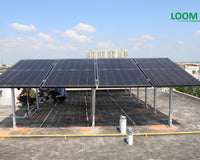

Solar panels are booming in India. While they have been a luxury for a decade, many government initiatives have made them no longer the exclusive domain of big corporations and wealthy households. As of 2024, the solar panel has officially entered the market of the middle class and now has surpassed 150 GW of installation capacity.
Millions of homeowners are stepping up to buy solar, but a single question that might have occurred in the minds of all people would be, “Should I buy the Indian solar panels or imported solar panels?”
Considering the market today consists of panels made in India and products imported from China, the US, South Korea, and Germany, that's a good question. Each solar comes with its own price point, performance profile, and service reality. This blog covers all the bases so you can make an informed, confident choice.
Understanding the Indian and imported solar panels
The Indian solar market has a strong rivalry between domestic solar and imported solar panels. Indian solar panels are made in India by Indian companies. Some of the popular domestic solar panel brands are Loom Solar, Tata Power Solar, Vikram Solar, Adani Solar, and Waaree , whose modules comply with Indian as well as international standards. India’s solar panel manufacturing capacity has seen a huge growth due to the government's Production Linked Incentive (PLI) scheme and ALMM (Approved List of Models and Manufacturers) policy introduced by the Ministry of New and Renewable Energy (MNRE).
Most importantly, Indian manufacturers are not restricted to the standard Mono PERC modules anymore. This is what is being produced in India now:
-
Mono PERC—Mass-market standard widely available.
-
TOPCon (N-type)—Companies like Adani Solar, Waaree, Vikram Solar, Avaada Electro, and others are shipping high-wattage TOPCon modules at scale.
-
HJT (Heterojunction Technology)—Some of the most advanced panels commercially available in India are Waaree’s Plexus HJT series and Vikram Solar’s expanded HJT lines.
-
Bifacial—Waaree, Adani, Vikram Solar, Goldi Solar, and others manufacture bifacial modules. Bifacial modules are now a standard product category among Indian Tier-1 brands.
Most imported solar panels come from China (which dominates global solar manufacturing), followed by the US, South Korea, and Germany. India has long welcomed Chinese brands like Longi, Jinko Solar, and Trina Solar for their competitive prices and high efficiency ratings.
But the landscape of solar imports in India has shifted. In April 2022, the government imposed a 40% Basic Customs Duty (BCD) on imported solar panels, significantly increasing the cost of imported options and pushing the market towards domestic manufacturing. Market data shows that, as of February 2026, Chinese Tier-1 panels are only 5–15% cheaper than Indian Tier-1 alternatives, compared to a 25–30% gap in 2022.
The shift is already happening, with the International Energy Agency (IEA) saying India is now one of the world’s top three solar manufacturers and is on track to become one of the world's top solar manufacturers by 2030.
Indian solar panels V/S Imported solar panels
For better understanding, below is the comparison between Indian solar panels and imported solar panels:
|
Features |
Indian solar panels |
Imported solar panels |
|
Efficiency |
The efficiency level is 20-23.3% |
The efficiency level is 21-24% |
|
Technology |
Mono PERC, TOPCon, HJT, Bifacial, Glass-Glass. |
TOPCon, HJT, Bifacial, PERC |
|
Quality standards |
BIS certification, ALMM listed |
IEC, TUV, UL certified |
|
Warranty |
25-30 year performance |
25-30 year performance |
|
Price Range (per watt) |
₹22-₹38/wp (tech dependent) |
₹30-₹45/wp (after BCD) |
|
Availability |
PAN India, as they are readily available. |
Limited, as they are imported from other countries |
|
After-sales support |
250-850+ service centers nationally. |
25-45 service partners nationally. |
|
ALMM compliance |
Yes, as it is mandatory |
Generally not compliant. |
|
Government Subsidies |
Fully eligible |
Not eligible |
Which Is Better for Indian Homeowners?
To decide which solar panels you should choose, here are some of the conditions/situations that can help you understand which solar panels are better for Indian homeowners:
Choose Indian solar panels if—
-
You want the government subsidy: For most of the Indian homeowners, this is the clearest deciding factor, as the subsidies like PM Surya Ghar Yojana provide subsidies for the 3 kW system of ₹78,000, which can only be applicable if the panel is ALMM listed. Due to which the imported panels are not qualified for these government subsidies.
-
You want reliable after-sales services: Due to the panels being domestic, it is more likely for you to get better after-sales services, as the Indian brand usually has at least 250-850 service centres across the country. Whereas the imported brand service partners are limited to only 25-45 service centres nationally.
-
Better performance in a hot summer: Due to India being a hot country, it usually gets around 250-300 clean sunny days, and the summer days crossing the temperature level of above 40°C make it harder for imported solar panels to perform efficiently, as the temperature coefficient of the Indian TOPCon N-type solar panels is engineered with a superior temperature coefficient that undergoes localized climate testing under harsh +45°C operating conditions.
Choose imported solar panels if—
-
You have limited roof space available: If you have limited roof space but higher electricity consumption than at this point, squeezing every inch of the rooftop matters. At this point, choosing the tier-1 TOPCon and HJT panels of the imported solar panels provides a better solution to get maximum energy generation from the rooftop with partial shading and limited space.
-
You are a commercial/industrial buyer: Due to the subsidy being centred only on residential buildings, the commercial/industrial buildings are not eligible to receive financial assistance from the PM Surya Ghar Yojana. This makes the priority list down to efficiency, price-per-watt, and supplier reliability, which can lead to these commercial/industrial buyers choosing the imported tier-1 panels for the best output.
-
You specifically need the high-tier HJT performance in coastal areas: While Indian HJT panels are excellent, the HJT product range from Korean and US manufacturers still surpasses the Indian HJT panels in providing the maximum PID resistance and low degradation, specifically in the coastal areas.
The Indian domestic solar industry is well supported by the Solar Energy Corporation of India (SECI) and the National Institute of Solar Energy (NISE), which have established quality standards and testing infrastructure for the industry.
Refer to the Solar Panel Installation Guide for Homeowners for step-by-step instructions on how to set up your system.
Cost comparison and long-term value
To understand the cost that needs to be acquired to buy a solar panel, we are going to understand it through the comparison of technologies and government subsidies available for financial assistance.
The panel-only prices in India are the following:
|
Technology |
Indian Panels (₹/wp) |
Imported Panels (₹/wp, Post-BCD) |
|
Mono PERC |
₹22-₹28 |
₹28-₹34 |
|
TOPCon |
₹28-₹35 |
₹33-₹40 |
|
HJT |
₹30-₹38 |
₹35-₹45 |
|
Bifacial |
₹32-₹38 |
₹38-₹46 |
Above is the market data from 50+ MNRE-empanelled installers from February to April 2026. Prices are indicative and vary by region, brand and order volume.
Following is the complete cost for a 3 kW on-grid solar rooftop system (before and after the subsidy):
|
Indian Panels |
Imported Panels |
|
|
Estimated system cost (before subsidy) |
₹165,000 - ₹210,000 |
₹190,000 - ₹255,000 |
|
PM Suriya Ghar Subsidy |
Up to ₹78,000 |
Not applicable |
|
Net cost (after subsidy) |
₹87,000 - ₹132,000 |
₹190,000 - ₹255,000 |
The subsidy alone makes the financial decision easier for the homeowners. A 5 kW system with Indian panels costs around ₹2.72 lakh net (after subsidy), as opposed to ₹3.25 lakh for an imported-panel system with no subsidy. And over 25 years, Indian panels give slightly better returns due to the lower upfront investment.
The payback period for residential systems in India is currently in the range of 3.5-6 years depending on system size, local electricity tariff and usage pattern.
To know more about the financing options in India, check out this blog for better understanding: solar financing & loan options in India.
Conclusion
In the big 2026, the India versus imported panels debate has been shifted significantly in India’s favour. Now, Indian manufacturers are producing the complete range of advanced panel technologies like mono PERC, TOPCon, HJT and bifacial, with efficiency ratings and warranties comparable to global standards.
Adding in the 40% import duty on foreign modules, the PM Surya Ghar subsidy that is limited to ALMM-listed Indian panels, and a far stronger domestic service network, and the case for Indian panels is compelling for the vast majority of homeowners.
For almost all residential use cases, the narrow efficiency advantage imported panels have at the very top end is outweighed by domestic options' cost, subsidy and service advantages. Homeowners who are on the lookout for reliable Made-in-India solar solutions can also check the range of high-efficiency solar panels by Loom Solar meant for the Indian climate.